
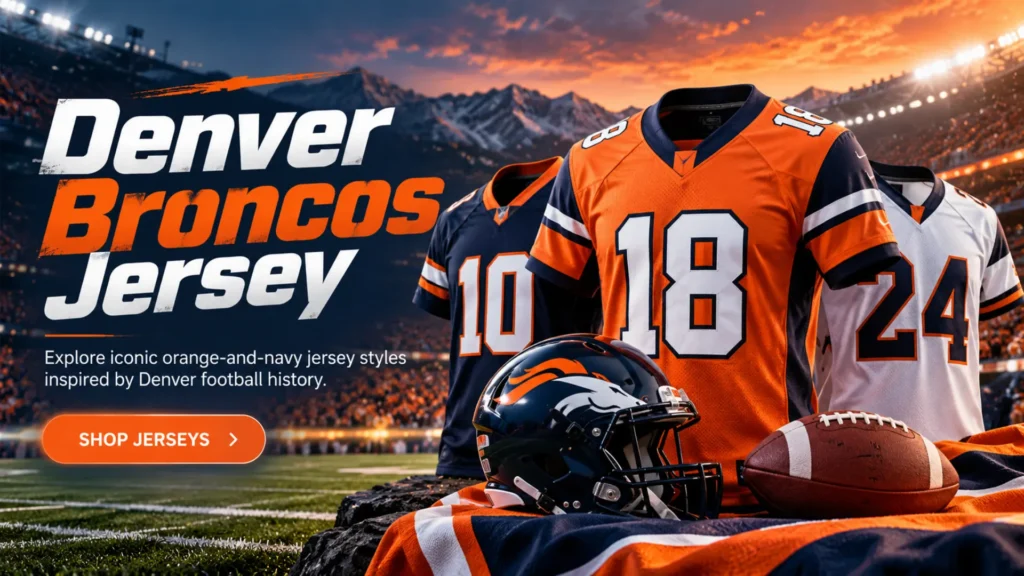
Denver Broncos History, Team Identity, and Jersey Culture
The Denver Broncos have been part of professional football since 1960, when the franchise began playing as a charter member of the American Football League. When the AFL and NFL completed their merger in 1970, Denver became part of the National Football League and eventually developed into one of the most recognizable teams in the AFC. The history of the Broncos includes difficult early seasons, major playoff runs, championship teams, memorable players, and a strong connection with football fans throughout Colorado and beyond.
Jerseys are closely connected with that history because team uniforms provide a visual record of different eras. Changes in colors, logos, striping, numbers, and overall design can immediately distinguish one period of Broncos football from another. For supporters and football-history enthusiasts, studying a jersey can therefore be about much more than clothing. It can provide context about when a player competed, how the team’s identity developed, and which design was associated with an important period in franchise history.
Contents
From the AFL Era to an Established NFL Franchise
Denver’s professional football story began in the American Football League in 1960. The Broncos struggled for much of their early history and did not record their first winning season until 1973. A major breakthrough arrived in 1977, when Denver reached the postseason for the first time and advanced all the way to Super Bowl XII. That season helped establish the Broncos as a serious national contender and strengthened football culture in the Rocky Mountain region.
The franchise later became a frequent participant on the NFL’s biggest stage. Denver has appeared in eight Super Bowls and has won three championships. The victories came in Super Bowls XXXII, XXXIII, and 50, representing championship seasons from two different periods of team history. Those accomplishments also created distinct generations of Broncos uniforms, photographs, memorabilia, and fan traditions that remain recognizable decades later.
How the Broncos Visual Identity Changed Over Time
The Broncos have not always looked the way modern fans recognize them. The earliest uniforms from the AFL period were substantially different from the orange, navy, and white identity associated with later Denver teams. Over time, the franchise refined its colors and visual presentation, with orange becoming particularly important to the team’s public identity.
One of the most familiar historical symbols is the “D” logo featuring a bucking horse, which was strongly associated with the Broncos for decades. A major redesign arrived in 1997, introducing the modern horse-head logo and a darker navy-based uniform design. The timing of that redesign became historically significant because Denver won consecutive Super Bowls during the 1997 and 1998 seasons. As a result, uniform design can help identify whether an item or photograph belongs to an earlier Orange Crush-era team, the championship period of the late 1990s, or a later generation.
Understanding Football Jerseys in Historical Context
A football jersey becomes more informative when it is connected to a specific player, season, uniform design, and team era. A number alone is not always enough to establish that context. Numbers are frequently reused by professional teams, while players can change teams or occasionally change numbers during their careers. Reliable identification therefore depends on considering several details together.
For Broncos history, details such as the logo style, typeface, sleeve treatment, color arrangement, player name, and number can help narrow down the period represented by a jersey. Modern reproductions and fan apparel can also resemble older designs, so visual similarity does not necessarily mean that an item was manufactured during the same period in which the original uniform was worn.
Historic Broncos Players and the Numbers Fans Remember
Several players became closely associated with important periods in Denver history. Quarterback John Elway wore number 7 and played his entire NFL career with the Broncos from 1983 through the 1998 season. His career included five Super Bowl appearances as a player and ended with consecutive championships. Those achievements made the number 7 jersey one of the most recognizable pieces of Denver football imagery.
Other important Broncos eras produced their own familiar names and numbers. Running back Terrell Davis, wearing number 30, played a central role in Denver’s late-1990s championship teams and was named the Most Valuable Player of Super Bowl XXXII. Linebacker Von Miller, wearing number 58, later became one of the defining players of the team’s 2015 championship season and was named MVP of Super Bowl 50. Understanding these connections helps place jerseys within the larger history of the franchise rather than treating them simply as apparel.
Why Uniform Details Matter When Identifying an Era
Football uniforms change for many reasons, including branding decisions, league rules, manufacturing developments, anniversary programs, alternate-uniform concepts, and changes in design preferences. Small differences can therefore provide useful clues about when a particular style was used.
When researching an older Broncos design, it is useful to examine the team logo, the shape and placement of numbers, shoulder or sleeve elements, nameplate construction, and the combination of primary and secondary colors. Photographs from documented games can also help explain how a particular uniform style appeared on the field. These details are especially important when distinguishing a historically accurate design from a later throwback or commemorative interpretation.
Jerseys as Part of Sports History and Fan Culture
Team jerseys also show how professional football connects generations of supporters. A fan may associate one design with games watched during childhood, while another design may represent a championship run or a favorite player. Older uniforms can therefore function as cultural objects that preserve memories of particular periods in a team’s history.
For historians and collectors, the most useful approach is to separate documented history from assumptions. A jersey design can represent a specific football era without necessarily being an original game-used item. Likewise, a player’s name on a retro-style jersey does not prove that the exact construction was used during that player’s career. Clear distinctions between historical uniforms, licensed reproductions, fan apparel, throwbacks, and game-used equipment make discussions of sports memorabilia more accurate.
Exploring Denver Broncos History Through the Details
Denver Broncos history can be studied through seasons, players, coaches, stadiums, playoff performances, logos, and uniforms. Looking at these subjects together provides a clearer picture of how the franchise developed from an AFL expansion-era team into a three-time Super Bowl champion.
DenverBroncosJerseysPop.com is intended to document and explain those connections through informational articles. The focus is on football history, jersey design, player-era context, and the details that help readers understand what they are seeing. Rather than treating jerseys simply as products, this site approaches them as part of the broader story of professional football in Denver.
What is the history of the Denver Broncos?
The Denver Broncos were founded in 1960 as a charter member of the American Football League (AFL) before joining the NFL in 1970. The team has won three Super Bowl championships and is known for its passionate fan base and historic players.
Who are some of the most famous Denver Broncos players?
Some of the most famous Denver Broncos players include John Elway, Terrell Davis, and Von Miller. These players played important roles in the team’s history and contributed to its Super Bowl victories.
What colors and logos are associated with the Denver Broncos jerseys?
Denver Broncos jerseys are known for their orange, navy blue, and white colors. The team has used several logos throughout its history, including the classic “D” logo featuring a bucking horse and the modern horse-head logo introduced in 1997.