
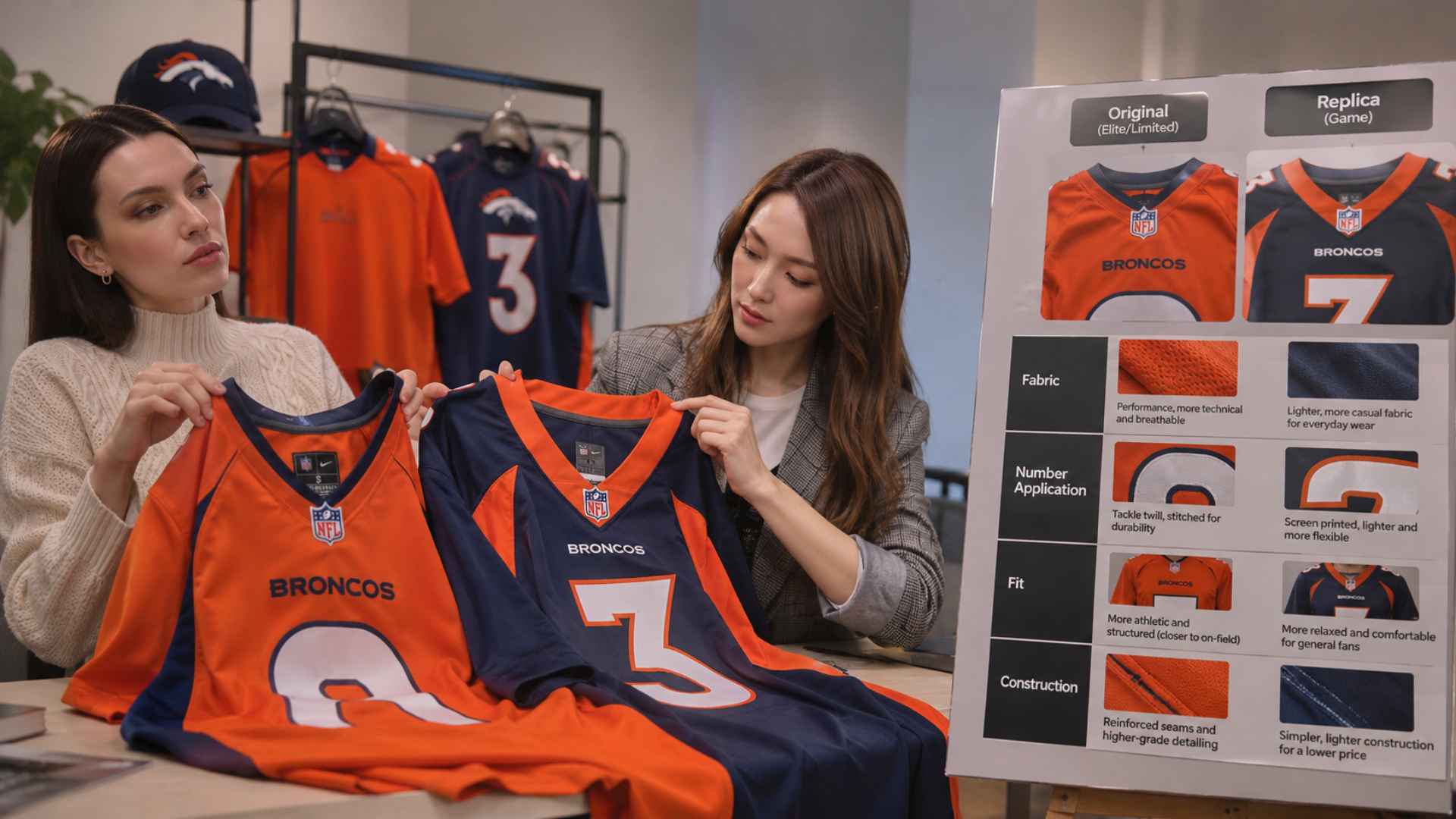
NFL jerseys can look nearly identical from a distance, yet their construction may differ considerably. Denver Broncos supporters encounter several retail versions of the team’s uniform, from casual fan apparel to garments closely modeled on equipment used by professional players. The distinctions involve fabric structure, number application, body shape, and price rather than team colors alone. Those differences also explain why two licensed jerseys bearing the same player number may feel noticeably different.
Terms such as “authentic” and “replica” are often used broadly, which can create confusion. In NFL retail, an officially licensed replica is still legitimate merchandise. The word “replica” describes how closely a product reproduces an on field uniform, not whether it is counterfeit. Conversely, an expensive jersey is not automatically an exact copy of the equipment issued to an individual player.
Nike’s NFL range provides a practical framework for comparing these products. Game jerseys focus on everyday fan wear, Limited jerseys occupy an intermediate category, and Elite jerseys most closely resemble professional uniforms. Features vary by generation and specific product, so the category name and garment description matter more than an assumption that every jersey from a given year has identical construction.
Authentic and Replica Terminology in NFL Jerseys
In retail terminology, “authentic” usually refers to a jersey made with a player inspired cut and construction details associated with elite on field apparel. Nike’s Elite line, for example, incorporates performance oriented fabric, ventilation zones, and sewn on twill lettering and numbers. These elements are intended to approximate professional uniform specifications, although retail versions can differ from garments customized for players.
Replica generally refers to a lower priced version designed to reproduce the recognizable appearance of a team uniform without every technical feature. Nike Game jerseys use screen printed graphics and ventilation panels to provide a lighter casual garment. The Limited category sits between these approaches. Importantly, Game, Limited, and Elite products can all be officially licensed, so authenticity in the licensing sense must be kept separate from authenticity of uniform construction.
Construction Differences That Affect the Jersey
The clearest differences appear when examining a jersey at close range. Authentic style models typically use more complex fabric panels, substantial number materials, and a closer relationship to the team’s on field pattern. Replica models simplify certain elements to reduce weight and production complexity. Denver introduced its Mile High Collection in April 2024, featuring Sunset Orange, Summit White, and Midnight Navy. These designs can be represented across different retail tiers, but matching colors or logos does not mean the garments share identical textiles, seams, or fit.
Fabric and Ventilation
Elite jerseys use performance materials with strategically placed ventilation, designed around movement and airflow. Game jerseys commonly incorporate breathable mesh side panels, emphasizing comfort for spectators rather than contact sport demands. Limited jerseys use sweat wicking fabrics; Nike’s Dri FIT technology moves moisture away from the skin to support evaporation. These are construction differences, not proof that one version will always feel cooler, since temperature, layering, and individual fit also influence comfort.
Player Names, Numbers, and Logos
Number application is one of the easiest details to inspect. Game jerseys typically feature screen printed names and numbers, whereas Elite versions use sewn on twill elements. Limited jerseys require closer attention: some Vapor F.U.S.E. editions have heat sealed twill components, while newer stitched Limited editions use sewn down details. The application method should therefore be checked on the specific garment rather than inferred from the word “Limited.” Official team marks and NFL shield details also vary with the tier and model year. Denver’s 2024 uniforms include mountain inspired design elements, which can be reproduced differently across fan apparel constructions.
Fit and Everyday Wear
Elite models generally have a performance oriented silhouette, with structural features influenced by football equipment. Game models tend to allow a more relaxed fit, particularly in men’s sizing. Limited fit varies across models and production generations, while women’s and youth versions follow their own size patterns. Measurements are more reliable than comparing size labels alone. Chest width, length, and shoulder shape should be considered separately, especially when a jersey is worn over a hoodie. Someone accustomed to wearing a loose Game jersey should not assume an Elite jersey with the same letter size will provide equivalent room at the shoulders or chest.
Durability, Price, and Long Term Care
Durability depends on both materials and use. Sewn on numbers are physically attached to the fabric, while screen printing forms a surface graphic that may eventually show wear from abrasion or repeated laundering. Neither construction guarantees a particular lifespan. Heat sealed details can also remain intact for years when treated properly, but excessive heat may damage adhesives. Fabric snagging, stretched collars, and damaged seams are possible in any tier.
Retail pricing reflects these differences without serving as a reliable quality test by itself. NFL Shop’s jersey guide lists Game jerseys starting at $149.99, Limited jerseys from $174.99, newer stitched Limited versions from $199.99, and Elite jerseys from $399.99. Actual prices depend on the player, customization, release, retailer, and date. The substantial spread reflects different construction and positioning, but it does not mean an Elite jersey is necessary for ordinary stadium attendance or casual use.
Care instructions remain important regardless of tier. Most fan jerseys are made from polyester, and garment labels take priority over general advice. Turning a jersey inside out, using a gentle wash cycle, avoiding bleach, and limiting heat exposure help protect printed graphics and applied lettering. Air drying is often the safer choice when care labels permit it. For Broncos supporters, the relevant distinction is practical: replica styles preserve recognizable team identity in casual clothing, while authentic style jerseys prioritize details closer to the professional uniform. Identifying the actual product tier, production generation, and graphic application method gives a more accurate comparison than relying on the words “authentic” or “replica” alone.